
How to Ride the Metro in Mexico City: Fares, the Tarjeta MI Card, Lines, Hours and Safety Tips
Quick answer: If you want to know how to ride the Metro in Mexico City, it’s simpler than it looks: every trip costs 5 pesos (about 25 U.S. cents, depending on the exchange rate), transfers inside the system are free, and you can tap a contactless bank card at the turnstile or use the rechargeable Integrated Mobility Card (Tarjeta de Movilidad Integrada, or Tarjeta MI), which costs 15 pesos. Trains run from 5 a.m. on weekdays, 6 a.m. on Saturdays and 7 a.m. on Sundays and holidays, until midnight every day.
The Mexico City Metro has 12 lines and 195 stations and, according to the Metro system (STC Metro), carries more than 4.5 million passengers a day. For visitors it is the cheapest and often the fastest way across a city where traffic can turn a 20-minute drive into an hour. This guide is the first in our Getting Around series.
How to Ride the Metro in Mexico City: Know Before You Go
- Fare: 5 pesos per entry, no matter how far you go or how many lines you change.
- How to pay: a contactless debit or credit card (or a phone wallet) tapped on the turnstile validator, or a Tarjeta MI loaded with credit. Paper tickets were retired on March 1, 2024, according to the Mexico City government.
- Card cost: 15 pesos for the Tarjeta MI, plus whatever credit you load (maximum balance 500 pesos).
- Hours: Monday to Friday 5 a.m. to midnight; Saturday 6 a.m. to midnight; Sundays and holidays 7 a.m. to midnight.
- Rush hours to avoid: roughly 7 to 10 a.m. and 5 to 9 p.m. on weekdays, according to the city’s official visitor guide.
- Women and children: the front cars of most trains are reserved for women and young children; look for the signs on the platform.
- Help: the Metro says it answers WhatsApp messages at +52 55 5009 1930 during service hours.
Step 1: Get a Tarjeta MI or Use Your Contactless Card
The easiest option for a short trip is to tap a contactless bank card (look for the wave symbol) or a phone wallet on the turnstile reader. The Metro says each person needs their own card to enter, so if you are traveling as a group, either everyone taps their own card or you buy a Tarjeta MI for each person.
If you are staying more than a couple of days, buy the Tarjeta de Movilidad Integrada. It costs 15 pesos at Metro ticket booths (taquillas) and vending machines, and at machines in Metrobús, Cablebús and Tren Ligero (light rail) stations. You can reload it with cash at any Metro ticket booth, and the screen above the turnstile shows your remaining balance after each tap. The same card works on the Metrobús, Cablebús, Tren Ligero, trolleybuses, RTP city buses and ECOBICI bike share, so it’s worth having. The city’s tourism site also says the card can be topped up from a phone with NFC using the official App CDMX.
Tip: ticket booths sometimes run out of cards. If that happens, try another booth in the same station or a nearby Metrobús station machine.
Step 2: Find Your Line and Direction
Each line has a number (or letter) and a color, and every station has its own icon, a system created for the original network in the late 1960s. Directions are named after the last station on the line, so before you go down to the platform, check which end of the line you are heading toward. For example, on Line 2 (blue), trains run toward either Cuatro Caminos or Tasqueña. Network and neighborhood maps are posted on platforms and in corridors.
Mexico City Metro lines tourists use most
- Line 1 (pink), Pantitlán–Observatorio: the oldest line, opened in 1969 and recently modernized. Useful stations include Insurgentes (for Roma Norte, Condesa and Juárez), Sevilla and Chapultepec (for Chapultepec Park).
- Line 2 (blue), Cuatro Caminos–Tasqueña: the historic-center line, with stops at Zócalo/Tenochtitlan (read our history of the Zócalo before you go), Allende and Bellas Artes. At Tasqueña you can transfer to the Tren Ligero toward Xochimilco and the Mexico City Stadium.
- Line 3 (olive green), Indios Verdes–Universidad: north–south line for Coyoacán and the UNAM university campus.
- Line 5 (yellow), Politécnico–Pantitlán: stops at Terminal Aérea, next to Terminal 1 of Mexico City International Airport.
- Line 6 (red), El Rosario–Martín Carrera: La Villa-Basílica station is the closest to the Basilica of Guadalupe.
- Line 7 (orange), El Rosario–Barranca del Muerto: the system’s deepest line. Polanco and Auditorio stations serve the Polanco hotel zone, the National Auditorium and the Chapultepec Park area.
- Line B (green and gray), Buenavista–Ciudad Azteca: Buenavista is next to the Biblioteca Vasconcelos library.
Coming from the airport? Our Mexico City airport to Roma Norte and Condesa guide compares the Metro with taxis, Uber and the Metrobús.
Step 3: Enter, Transfer and Exit
- Tap your card at the turnstile. You only pay when you enter; you don’t need to tap out.
- Follow the signs for your line color and the terminal station in your direction.
- To change lines, follow the “Correspondencia” (transfer) signs. Transfers inside the Metro are free, but some, like Pantitlán and Hidalgo, involve long walks and big crowds.
- When you arrive, follow “Salida” (exit) signs. Large stations have several exits, and the neighborhood maps help you choose the closest one to your destination.
Best Times to Ride the Mexico City Metro
The city’s official visitor guide lists the busiest periods as roughly 7 to 10 a.m. and 5 to 9 p.m., and warns that rain makes delays worse. For sightseeing, mid-morning (after 10 a.m.) and early afternoon on weekdays are the most comfortable. Weekend mornings are usually calmer, but remember the Metro opens later on Saturdays (6 a.m.) and Sundays (7 a.m.). If you’re out late, give yourself time: the system closes at midnight, and you can’t stay in stations after service ends.
Traveling with luggage? Rush-hour cars can be packed tight, which makes big suitcases hard to manage. For airport runs with heavy bags, an authorized taxi, an app ride or the Metrobús airport route is often easier.
Is the Mexico City Metro Safe? Practical Safety Tips
Millions of people ride every day, and most visitors use it without problems, but pickpocketing in crowded cars is the main risk. The city’s official guide recommends:
- Wear your backpack or bag on your front in crowded areas.
- Keep your phone and wallet out of back pockets and outside pockets.
- Stay alert during transfers, when crowds push through narrow corridors.
- Avoid flashy jewelry and expensive-looking bags.
- Skip peak rush hour when you can.
The front cars reserved for women and children are a good option for women traveling alone, especially at busy times. If something goes wrong, look for Metro staff or police in the station, or use the Metro’s assistance modules at key stations such as Insurgentes, Hidalgo, Zócalo/Tenochtitlan, Balderas and Centro Médico. For a wider look at safety, read our guide: Is Mexico City safe for tourists right now?
Metro vs. Metrobús, Scooters and Ride Apps
The Metro is usually the fastest option for long trips across the city. The Metrobús (rapid-transit buses in dedicated lanes, especially along Insurgentes Avenue) is handy for Roma, Condesa and the south. For short hops, many visitors walk or use bikes and scooters; check our explainer on Mexico City electric scooter rules before you ride one. Late at night, an app ride or authorized taxi is generally the more comfortable choice. More guides in this Getting Around series, including the Metrobús, taxis, Uber and DiDi, and car rentals, are on the way.
Mexico City Metro FAQ
How much does it cost to ride the Metro in Mexico City?
5 pesos per trip, with free transfers between lines inside the system. The Tarjeta MI card costs 15 pesos once.
Can I pay the Mexico City Metro with a credit card?
Yes. The Metro accepts contactless debit and credit cards and phone wallets at the turnstile validators. Each rider needs their own card.
Where do I buy a Mexico City Metro card?
At Metro ticket booths and vending machines, or at the machines in Metrobús, Cablebús and Tren Ligero stations.
What time does the Mexico City Metro close?
At midnight every day. It opens at 5 a.m. on weekdays, 6 a.m. on Saturdays and 7 a.m. on Sundays and holidays.
Does the Mexico City Metro go to the airport?
Yes. Line 5’s Terminal Aérea station is next to Terminal 1. Terminal 2 is better served by the Metrobús airport route or a taxi.
Fares, hours and rules come from the Mexico City Metro (STC Metro) and the Mexico City government’s official visitor guide. Fares can change; this guide reflects official information current as of November 2026.
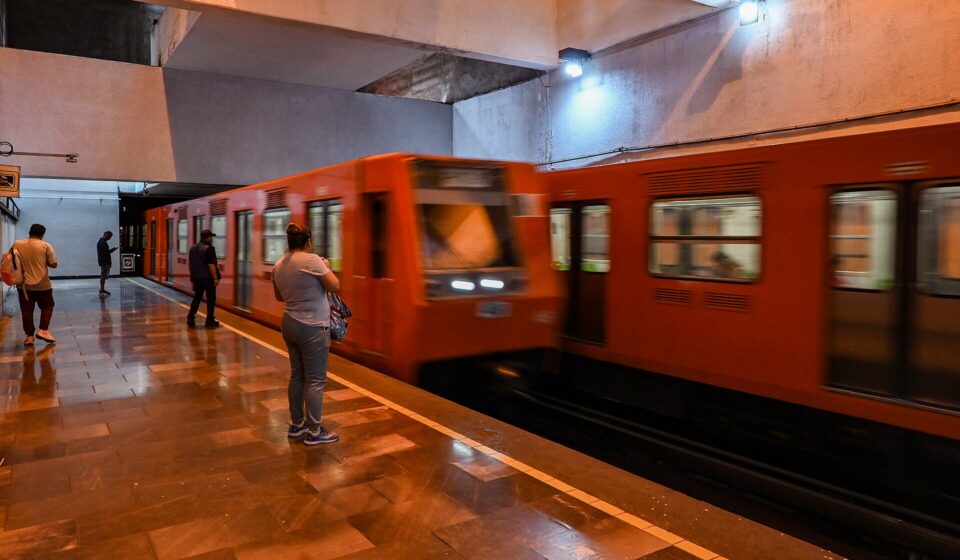
Photo: A Line 9 Metro train arrives at Patriotismo station in Mexico City. Photo by ProtoplasmaKid, via Wikimedia Commons, licensed under Creative Commons Attribution-ShareAlike 4.0 International (CC BY-SA 4.0), creativecommons.org/licenses/by-sa/4.0. Resized for web.