History of the Zócalo in Mexico City: From Aztec Tenochtitlan to Plaza de la Constitución
Quick answer: The history of the Zócalo in Mexico City stretches back nearly 700 years: the square sits beside the ceremonial heart of the Aztec (Mexica) capital, Tenochtitlan, became the Plaza Mayor of Spanish colonial Mexico City after 1521, was renamed Plaza de la Constitución in 1813, and got its nickname, “Zócalo,” from the base of an independence monument that was never finished. Today it is the country’s main stage for celebrations, concerts and protests.
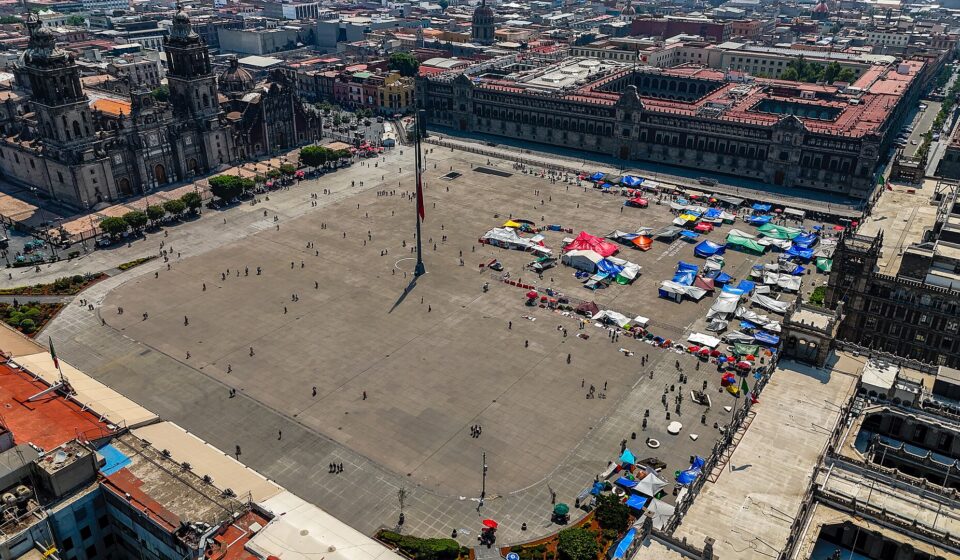
Standing in the middle of the Zócalo, you are surrounded by layers of Mexican history: the Metropolitan Cathedral to the north, the National Palace to the east and, just off the northeast corner, the excavated ruins of the Templo Mayor. Here is how this huge square became the center of Mexico City, and how to visit it today.
Zócalo History at a Glance
- Official name: Plaza de la Constitución (Constitution Square).
- Aztec era: open space at the center of Tenochtitlan, next to the walled sacred precinct of the Templo Mayor.
- 1521 onward: laid out as the Plaza Mayor of the new Spanish city.
- 1813: renamed after the Spanish Constitution of Cádiz.
- 1840s: an independence monument is planned, but only its base, the “zócalo,” is built.
- 1987: the Historic Centre of Mexico City, including the square, is inscribed on UNESCO’s World Heritage List together with Xochimilco.
Before the Zócalo: Tenochtitlan’s Ceremonial Heart
According to Mexica tradition, the city of Tenochtitlan was founded on an island in Lake Texcoco in 1325, at the spot where the wandering Mexica saw an eagle perched on a cactus, a founding legend that still appears on Mexico’s flag. Over the next two centuries it grew into one of the largest cities in the Americas.
The land the Zócalo covers today was an open area at the center of that city. Just to the north and northeast stood the walled sacred precinct with the Templo Mayor, the great twin temple dedicated to Huitzilopochtli and Tláloc, which the Mexica considered the center of their universe. On the east side stood the palace of the ruler Moctezuma II, where the National Palace is today, and to the west stood the older palace of Axayácatl. Major causeways crossing the lake met near this point, dividing the city into four quarters.
The Colonial Plaza Mayor (1521–1821)
After the Spanish and their Indigenous allies conquered Tenochtitlan in 1521, Hernán Cortés had the new capital built on top of the ruins. The surveyor Alonso García Bravo laid out the street grid of what is now the Historic Center, with a large main square, the Plaza Mayor, at its heart. Cortés built his own residence over the remains of Moctezuma’s palace; it later became the seat of the viceroys and, after independence, the National Palace.
A first church went up on the north side, and in the second half of the 16th century work began on the much larger Metropolitan Cathedral, which took around two and a half centuries to finish. Its main facade faces south onto the square, which is why the plaza still feels oriented north to south.
Colonial life on the plaza was messy and lively. A flood in 1629 left the square under about two meters of water. In 1692 a riot set the viceroy’s palace on fire. From 1703 a large market building called the Parián, which sold luxury goods brought on the Manila galleons from Asia, occupied the southwest corner, while makeshift stalls crowded much of the rest.
In 1789 the Spanish crown ordered the square cleared, and the viceroy, the second Count of Revillagigedo, had it repaved and drained. During that work, in 1790, workers uncovered two of the most famous Aztec sculptures ever found: the statue of the goddess Coatlicue and the great carved disk known as the Sun Stone, or “Aztec Calendar.” Both are now in the National Museum of Anthropology. In 1803 the plaza received an equestrian statue of King Charles IV by sculptor Manuel Tolsá; it was later moved and now stands in front of the National Art Museum (MUNAL).
Why Is It Called the Zócalo? Independence and the 19th Century
On May 22, 1813, during the War of Independence, colonial authorities swore allegiance to the Spanish Constitution of Cádiz (signed in 1812) in the square, and it was renamed Plaza de la Constitución, a name it keeps today.
After Mexico won independence in 1821, the plaza changed again. In December 1828 the Parián market was looted during a riot, and President Antonio López de Santa Anna had it demolished in 1843. Santa Anna then planned a monument to independence for the center of the square, but only its base was built. In Spanish, a base or plinth is a zócalo, and people began calling the whole square by that name. The nickname stuck so firmly that many other Mexican cities now call their own main squares “zócalos.”
Later in the century the square was turned into a garden promenade with fountains and benches, and in 1878 a kiosk was installed on top of the old monument base. Streetcar lines also ran through the plaza and were electrified in the 1890s.
The Zócalo in the 20th Century
The square has been at the center of Mexico’s modern political life. During the Decena Trágica, the “Ten Tragic Days” of February 1913, fighting in the capital damaged the area around the National Palace. In 1968 the Zócalo saw large student demonstrations, and the same year it was the starting point of the Olympic marathon.
By the 1970s the gardens and tram tracks had been removed and the square was paved into the wide open plaza visitors know today, with a giant Mexican flag on a flagpole at its center. In 1978 electrical workers digging just northeast of the square uncovered a huge carved stone of the moon goddess Coyolxauhqui, which led to the excavation of the Templo Mayor and the opening of its site museum. In 1987 UNESCO added the Historic Centre of Mexico City to its World Heritage List.
The Zócalo Today
Today the Zócalo is still the country’s main public stage. Every September 15, Mexico’s president gives the “Grito” independence cry from a balcony of the National Palace to crowds in the square. It hosts free concerts, book fairs, holiday displays and, since 2016, a Day of the Dead parade inspired by the opening scene of the James Bond film Spectre. It is also Mexico’s best-known place for protests and political rallies, and protest camps are a common sight. The giant flag is raised and lowered in a daily military ceremony.
Visiting the Zócalo Today: Know Before You Go
- Location: Plaza de la Constitución, Centro Histórico, Cuauhtémoc borough.
- Nearest Metro: Zócalo/Tenochtitlan station on Line 2 (blue), whose entrance is in the square itself. Allende (Line 2) and Pino Suárez (Lines 1 and 2) are short walks away. New to the system? Read our guide on how to ride the Metro in Mexico City.
- Cost: the square is a public plaza and free to walk around.
- Templo Mayor Museum and archaeological site: Seminario 8, beside the Cathedral. INAH lists hours as Tuesday to Sunday, 9 a.m. to 5 p.m. (closed Mondays), with admission at 210 pesos for foreign visitors and 105 pesos for Mexican nationals and foreign residents of Mexico; Sundays are free for Mexicans and residents.
- Best time to go: weekday mornings are the calmest. Midday sun is strong, as there is almost no shade on the plaza, so bring a hat and water.
- Heads-up: the plaza is often partly fenced off for concerts, official events, stage set-ups or protest camps, so what you see may differ from postcard views.
Safety Tips for the Zócalo and Historic Center
- Crowds attract pickpockets: keep your phone and wallet in front pockets or a zipped bag.
- Large marches often end in the Zócalo. If you see a protest arriving, step aside and avoid getting caught in the crowd; check local news before heading downtown.
- After dark, stick to busy, well-lit streets such as Madero, and use an app ride or authorized taxi to get back to your hotel.
For a broader picture, see Is Mexico City safe for tourists right now?, and if you’re just landing, our airport transportation guide covers taxis, Uber and the Metrobús.
Zócalo Mexico City FAQ
Why is it called the Zócalo?
“Zócalo” means base or plinth. In the 1840s Santa Anna planned an independence monument for the center of the square, but only the base was built, and the name stuck to the whole plaza.
What is the official name of the Zócalo?
Plaza de la Constitución, named after the Spanish Constitution of Cádiz, which was sworn in the square in 1813.
What was the Zócalo before the Spanish arrived?
It was an open area at the center of the Aztec capital Tenochtitlan, beside the sacred precinct of the Templo Mayor and the palace of Moctezuma II.
Is the Zócalo free to visit?
Yes. The plaza is public and free. Museums around it, such as the Templo Mayor, charge admission.
How do I get to the Zócalo by Metro?
Take Line 2 (blue) to Zócalo/Tenochtitlan station, which opens directly onto the square.
Historical information is based on published histories of the Plaza de la Constitución and Mexico City’s Historic Center, UNESCO’s World Heritage listing, and the National Institute of Anthropology and History (INAH). Museum hours and fees are from INAH and may change.
Photo: Aerial view of the Zócalo (Plaza de la Constitución) with the Metropolitan Cathedral and the National Palace, June 2024. Photo by ProtoplasmaKid, via Wikimedia Commons, licensed under Creative Commons Attribution-ShareAlike 4.0 International (CC BY-SA 4.0), creativecommons.org/licenses/by-sa/4.0. Resized for web.